Designing for Flux
A Conversation on Space, Meaning, and the Beauty of Becoming

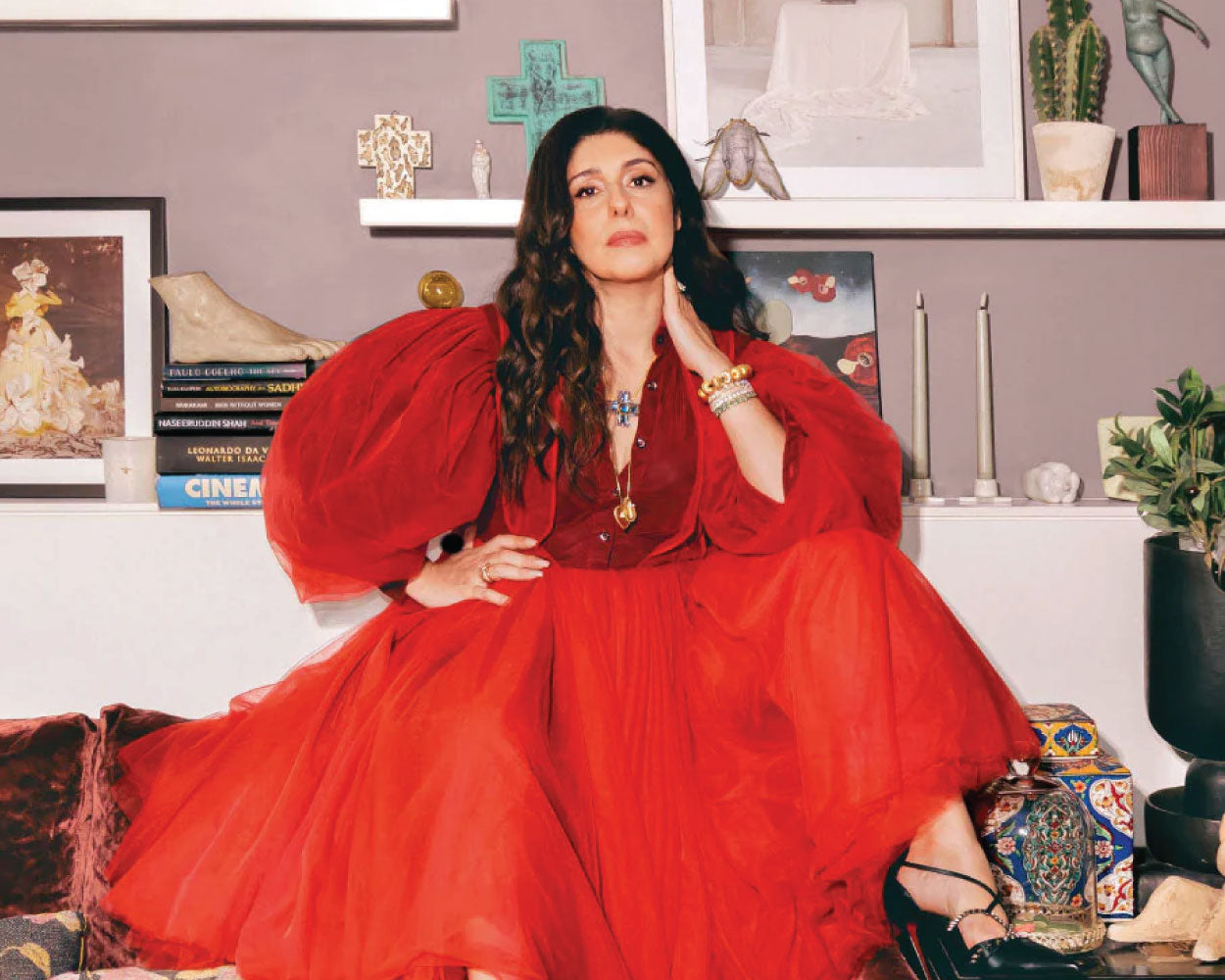
We spoke to Smita, founder of Multitude of Sins and an avid QUOD collector, about space, meaning, and the beauty of becoming. This conversation arrives at a fitting moment as Smita’s studio has been announced the Best Young Interior Design Firm, 2025 by Architizer New York.

Q. How do you reconcile the idea of permanence in interior architecture with the impermanence of lived experience?
(What happens when form is fixed but people, contexts, and cultures remain in flux?)
Permanence is a tricky idea in design, isn’t it? We often think of architecture as something solid, lasting, unchanging. But honestly, life itself is anything but static. People change, cultures shift, contexts evolve, and nothing stays still for long.
When I design, I don’t see form as something fixed in stone. I see it as a starting point, a kind of conversation starter. It’s like planting a seed, and what grows around it depends on so many things beyond our control. The form is there, but life is what happens around it, within it, sometimes despite it.
This is where I see design as an opportunity, an invitation to open minds and introduce new perspectives. A space isn’t just about the physical form; it’s about what that form can inspire, challenge, or shift in the way people see things. It’s about giving a new direction, a different vantage point, so that when people step into that space, they’re encouraged to perceive differently and think beyond what they’ve known before.
From there, it’s up to them: how they perceive, how they feel, how they let their energy integrate into that space. Our role isn’t to dictate how they should experience it but to create fertile ground for their own discovery.
So, when form is fixed but everything else is in flux, the real challenge and beauty lie in designing environments that serve as catalysts—spaces that challenge, inspire, and open up possibilities. In that sense, I see architecture as a kind of conversation, a dialogue between what’s built and how it’s lived or perceived. In that dialogue, impermanence isn’t a problem to solve but an essential part of the process.
In the end, it’s about respecting the fluidity of human experience and designing with the understanding that what we create is never really finished; it’s always becoming.

Q. Can a space, experience, or building be autobiographical?
(In what ways does your work carry traces of your personal history, memories, or ideological leanings?)
Can a space or experience be autobiographical? I think it can, but not necessarily by design. Sometimes, I approach a project with the intention of making it so, using it as a mirror for my own thoughts, memories, or beliefs. But more often, I see spaces as opportunities, ways to explore paths I wouldn’t normally go down if I just stuck to my own story. They’re a way to step outside myself and see things from new angles, even if I’m the one shaping them.
That said, I know that as I design, there’s always a little “me” in it—my current mindset, my mood, what I’m curious about at that moment. It’s like a snapshot of where I am in life, how I see and understand the world right now. The way I interpret a client’s brief, the approach I take, the choices I make, all of that is influenced by who I am at that time.
My memories and personal history are less about specific stories and more about how I approach things, I guess: how I resist following trends and prefer doing what feels authentic to me. As I grow older, I see that my ideological leanings shift. I’ve learned to leave space, to listen more, to be less stubborn, to accept that what I believed at one point doesn’t have to stay true forever. That openness, that softness, is part of my process now.
In the end, I believe that staying true to who I am today is what matters most. My work reflects that. I believe it’s unpretentious, it’s rooted in my truths, but always with the awareness that those truths are fluid and evolving. I create spaces not to leave a mark of myself but to serve others, spaces that are honest in their purpose and honest in their imperfection. That’s where I find meaning.

Q. What, in your view, constitutes a “homegrown aesthetic,” and how can it resist becoming a mere visual trope?
(Especially in the context of globalised palettes and Pinterest-ready minimalism.)
The phrase “homegrown aesthetic” is often a euphemism for sticking to safe, predictable visuals or stereotypes that claim authenticity but have long since become superficial. It’s a safe echo chamber that’s afraid to evolve, afraid to challenge itself.
Influence is inherently plural and borderless. Good design, whether Indian or otherwise, doesn’t come from a static, “pure” source but from a dynamic process of synthesis. A designer taking influences from Indian crafts, for instance, isn’t necessarily claiming to produce “Indian design,” but rather channelling a set of skills and philosophies into a new, personal language. Authenticity, then, isn’t about rehashing known symbols but about integrating influences meaningfully, with depth and intent.
Clinging to a fixed idea of what is “homegrown” can lead to stagnation. It stifles experimentation and the emergence of new voices that are genuinely rooted in local contexts but aren’t beholden to stereotypes. This creates a cycle where “Indian design” becomes a visual shorthand: safe, predictable, and ultimately unchallenging.
In a world where borders are blurred and influences flow instantaneously, the idea of a fixed “homegrown” style becomes less relevant. Today’s globalized world demands fluidity. True “homegrown” design shouldn’t be about mimicking traditional visuals but about cultivating a sensibility, a way of thinking, a craft, an attitude that is uniquely personal yet informed by local skills and philosophies. This means embracing hybridization, experimentation, and a refusal to settle for superficial markers of “Indianness.” It’s about being brave enough to define what “homegrown” means in a contemporary, global context without being tethered to clichés.
In an age of homogenized palettes and Pinterest minimalism, resisting becoming a visual trope requires a refusal to settle for stereotypes and a commitment to creating work that’s complex, layered, and true to your own voice.

Q. Where do you locate architecture on the spectrum between art and infrastructure, and do you believe this line should blur?
(Is function always necessary? Is ornament ever sufficient?)
The question of where architecture sits on the spectrum between art and infrastructure presupposes a binary, yet both terms are inherently fluid. But before positioning architecture, we must interrogate what “function” truly means. Is it solely about traditional utility such as shelter, circulation, or safety? Or can function be broader, serving emotional, symbolic, or experiential purposes that aren’t strictly “functional” in the conventional sense?
In my view, function is contextual. A form that evokes emotion, provokes thought, or challenges perceptions can itself be a function—a tool for communication, reflection, or disruption. For example, a space designed to inspire awe or introspection serves a function that transcends mere utility. Conversely, a highly pragmatic space can be reinterpreted through ornament or spatial language to elevate its purpose beyond the ordinary.
The line between art and infrastructure should not be rigid but flexible, or better yet, contextually blurred. A space that disrupts expectations by reinterpreting a traditional element, like seating or lighting, isn’t necessarily less functional; it’s more. It fulfils a deeper role—culturally, emotionally, intellectually—while still serving practical needs.
Similarly, ornament, often dismissed as superficial, can be sufficient when it acts as a carrier of meaning, a visual language that deepens engagement rather than merely decorates. Ornament can be a form of storytelling, a vessel for cultural memory, or a provocative act that questions the very notion of “taste” and “order.”
In our practice, which is inherently experimental and art-driven, the challenge is to redefine the relationship: to see form not as a vessel of function or ornament, but as a medium of expression that embeds multiple layers of meaning—emotional, cultural, and conceptual—while still fulfilling practical needs.
The blurred line is not about abandoning function but expanding its definition. It’s about embracing ambiguity, where form, art, and function coexist and interact dynamically, creating spaces that are thought-provoking, emotionally resonant, and practically sound.

Q. What does it mean to be ethically rigorous in design practice today?
(Beyond sustainability checklists, what deeper responsibilities should a designer hold in relation to ecology, labour, and land?)
As an experimental interior practice driven by art and innovation, we’re honest about where we stand. We recognize that, in many ways, we’re not doing enough, especially when it comes to ecology. We push boundaries, but we also accept that our impact on land remains a challenge we need to confront more consciously.
What truly weighs on us is labour. We see the everyday realities: poor working conditions, lack of basic amenities like clean toilets and drinking water, and we know these issues are core to what makes our practice ethical or not. Every craftsman and worker involved in bringing our ideas to life should be treated with respect and dignity. That’s not optional; it’s fundamental.
Good work begins with respect: safe, humane environments where people feel valued, supported, and empowered. We have a responsibility to do better, not just in the grander ideas of land or ecology, but in how we treat the people who make them real. Giving recognition, celebrating their craft, and creating space for their voices to be heard is essential for creating a practice rooted in integrity.
It’s about being honest with ourselves, acknowledging where we fall short, and actively working to improve. Because at the heart of what we do, creativity and care must go hand in hand. That’s the only way to truly be responsible in this practice.

Q. Has the increasing commercialisation of design sharpened your critical lens, or softened it?
(How do you hold on to resistance when the system rewards conformity?)
The increasing commercialisation of design, especially in a system that favours conformity, is something I’ve always seen as a challenge, not a threat. Honestly, I’ve never been a system person. I thrive on walking a different path, creating work that may not always make immediate sense to the world but is driven by conviction, curiosity, and a refusal to follow the crowd.
Building work that doesn’t fit the mould isn’t about rebellion for rebellion’s sake. It’s about trusting the process, knowing that true impact is built over time, not through instant acceptance. Talent and genuine conviction are long-term investments. They don’t need the system’s validation to be meaningful. If anything, the system’s resistance confirms that you’re on the right track, pushing boundaries where others fear to tread.
Patience is a strategic tool. History shows us that the most disruptive ideas often face initial rejection because they threaten the comfort of the familiar. But real substance has a way of revealing itself over time. The challenge is to stay committed, not to fight the system directly, but to produce work that’s rooted in purpose and integrity, knowing that value will find its audience.
The system rewards conformity because it offers predictability, but true innovation is born from the courage to be misunderstood. That’s where real change begins, not with resistance alone, but with the unwavering belief that the work will speak for itself if we stay true, stay patient, and keep pushing forward.